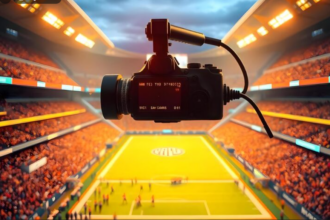
The helicopter was stuck in midair, camera operator hanging at a risky angle, and sharp gusts of wind disturbing everything. That is what an aerial shot used to look like in the early 2000s.
While each shot was expensive for the filmmakers, it was even riskier for the staff. One bad turn or a poorly positioned camera means your time and money will go to waste. Moreover, the camera operator has to risk his life just to get the right shot.
Now, things have changed.
Ariel shots have become an important part of the entertainment industry. From movies to sports and even vlogs, we see them everywhere.
This change is all thanks to the advanced drone technology. Now, anyone can get a midair shot without risking their lives or spending a lot of money.
While most people highlight the importance of these shots for movies, very few talk about the pivotal role of these clips in sports. In this write-up, we will explore the role of drones in modern sports, their filming, and overall analysis.
Why Do We Need Drones for Sports Coverage and Broadcasting?
In recent years, the sports industry has changed for good. From introducing new games that are much more lucrative, to improving broadcasting on older games, each aspect is now thriving.
Previously, where the game was relying more on the judgment of umpire and referee, things were uncertain. There was a huge room for mistakes and bad decisions. In games where a small decision of the umpire could change the course of the game, things became even more challenging.
However, using drones and advanced technology helps resolve these issues.
Here are some of the best ways sports broadcasting is changing, all thanks to the new technology:
Data Integration and Analysis
Capturing footage is a very small part of sports broadcasts. In reality, there is so much that most viewers do not know.
With the help of drones and advanced technology, channels get to collect real-time data of the players and game. This advanced technology of forming a network of drones to gather data is known as the Internet of Drone Things (IoDT).
The user is required to keep the drone connected to a stable internet connection like Xfinity, to stream and save high-quality footage in real-time. Consequently, this data collected via sensors is stored, sorted, and analyzed to predict the games in the future.
From the texture of the pitch in certain locations to the winning stats, each aspect of sports can now be predicted with extreme prediction, all thanks to drones and similar technology.
Coverage and Analysis
Ariel shots are very important in most sports, especially in outdoor sports with a large surface area or ground.
This coverage offers a bird’s eye view to the viewers, helping them understand the overall location of each player and their importance in positioning. Apart from this, coverage of the sports helps sports analysts to cover the technical details of the sports in depth.
Overall, technical analysis is much more fun and simpler by using drones and advanced technology.
Aesthetics and Angle
Broadcasting requires an in-depth understanding of overall sports aesthetics and technical details.
By using drones, channels can offer dynamic shots to make the sports event more fun for the viewers. Apart from this, better visuals are more appealing keeping the audience hooked for longer and giving them an immersive experience.
Experience and Engagement
Games are broadcast to the masses. While most of the audience likes the game for its aesthetics, some of the audience is into overall details, stats, and ranking.
By using advanced technology, especially drones, sports channels and event planners try to satisfy all kinds of audiences by offering them a more immersive visual experience.
How Drones Can Help With Sports Training And Coaching?
Most people think that the role of advanced technology especially drones is limited to broadcasting. However, so many other aspects are influenced by the use of drones. For instance, training and coaching for sports events and teams is a very important aspect linked with the use of drones.
Training via drone
Technical training for sports requires two important aspects i.e. one-on-one sessions and team training.
For one-on-one training sessions, coaches generally analyze the technique of each player, offer them advice, and help them make the most out of the time and overcome their issues. On the contrary, the team analysis is focused on the strategy building and overall planning of each game.
This requires a bird’s eye view, which is offered by the use of a drone. The coach gets to analyze the strategic format of the game and then offer advice accordingly. This session is very important for the captain as well as the whole team.
Performance Analysis
Post-game performance analysis is a very important part of coaching and training. This step helps the players to understand their mistakes, so they can overcome these issues later.
Apart from this, they get detailed feedback from the experts that can help them improve their skills and strategize their game better. Previously, post-game analysis was done without any visual help. However, now that drones and other technology are being used for performance analysis, players get an in-depth learning experience.
How Drones Can Be Used in Real Life For Sports Events Coverage?
Within the tech-driven world of sports, there are so many applications of drones. From traditional roles of monitoring and recording, to modern roles like security and event management, each step plays a very important role.
Here are some applications where drones outshine the traditional technology:
- Drones help in aligning the logistics of the sports event. Eventually, these logistics help with mapping the venue, understanding the condition of the pitch, and strategizing the game better.
- Using drones helps in designing a 3D map of the venue. Organizers plan the event better by using these 3D maps.
- Ariel surveillance is a great way to understand the condition of the field, which can help in planning the game depending on surface conditions.
- Drones are a great way to check seating arrangements and understand the seating preferences of the crowd.
- By using the drone, event organizers get to plan effective exit routes for the audience, to avoid emergencies like stampede.
- Drone surveillance is an excellent way to access any emergency situation, helping the event organizers offer swift solutions.
- Drone patrolling is a very popular method of keeping unauthorized individuals away from sports events and maintaining discipline.
What Are the Challenges of Drone Integration?
With so many advantages, one might question why drone integration is not normalized for every sports event. The answer is simple, like most technology that has countless advantages, drone integration also comes with its own unique challenges.
Here are some of the challenges related to drone integration:
- The use of drones offers a much clearer aerial shot. However, it can be considered an invasion of privacy. This invasion of privacy is not just limited to the team, players, and spectators but also the individuals living in the residential buildings closer to the sports ground.
- Drone flying requires a license and permission, especially because it is considered dangerous for aviation.
- Within public spaces, drone flying requires permission and passes, that are not granted to everyone unless they are associated with a corporation.
- Drone equipment can cause accidents when not maintained properly or handled correctly.
- Flight failure, loss of signals, and colliding mid-flight with birds and other objects are quite common when flying drones, which makes it dangerous for everyone.
- Some drones have a similar carbon footprint as a small plane, which can be quite dangerous for the environment.
- Older and run-down versions of drones are risky as they create debris and might malfunction mid-flight.
- Some versions of drones create loud noises, scaring away birds and adding to noise pollution.
How to Overcome the Challenges Related to Drone Integration?
There are a lot of challenges related to drone integration. However, there are so many different ways to overcome the above-mentioned challenges. Here are some of the simple steps that can facilitate drone integration within the sports industry:
- Drone operators need to be trained as per the policies rolled out by the government.
- Drone pilots need to fly drones in compliance with regulatory standards.
- Every drone pilot needs to have a drone maintenance certificate to ensure that their drone will not give up in midair.
- Safety should be the top priority of every drone owner and pilot.
- Companies working on drone technology should introduce quieter drones to avoid noise pollution.
- Overall carbon footprint of drones should be reduced for an eco-friendly flight.
- Alternative and sustainable energy sources should be explored for flying and fueling drones.
Simply put, using drones is helping event companies and broadcast channels to enhance the overall experience of the event.
This technology has played a pivotal role in boosting the safety of the event, logistics, and overall fan experience. However, for the dominance of drones within the sports industry, challenges including ethical, legal, environmental, and safety issues need some attention.